
Hotel Dryer Vent Cleaning in Denver: A Laundry Maintenance Plan
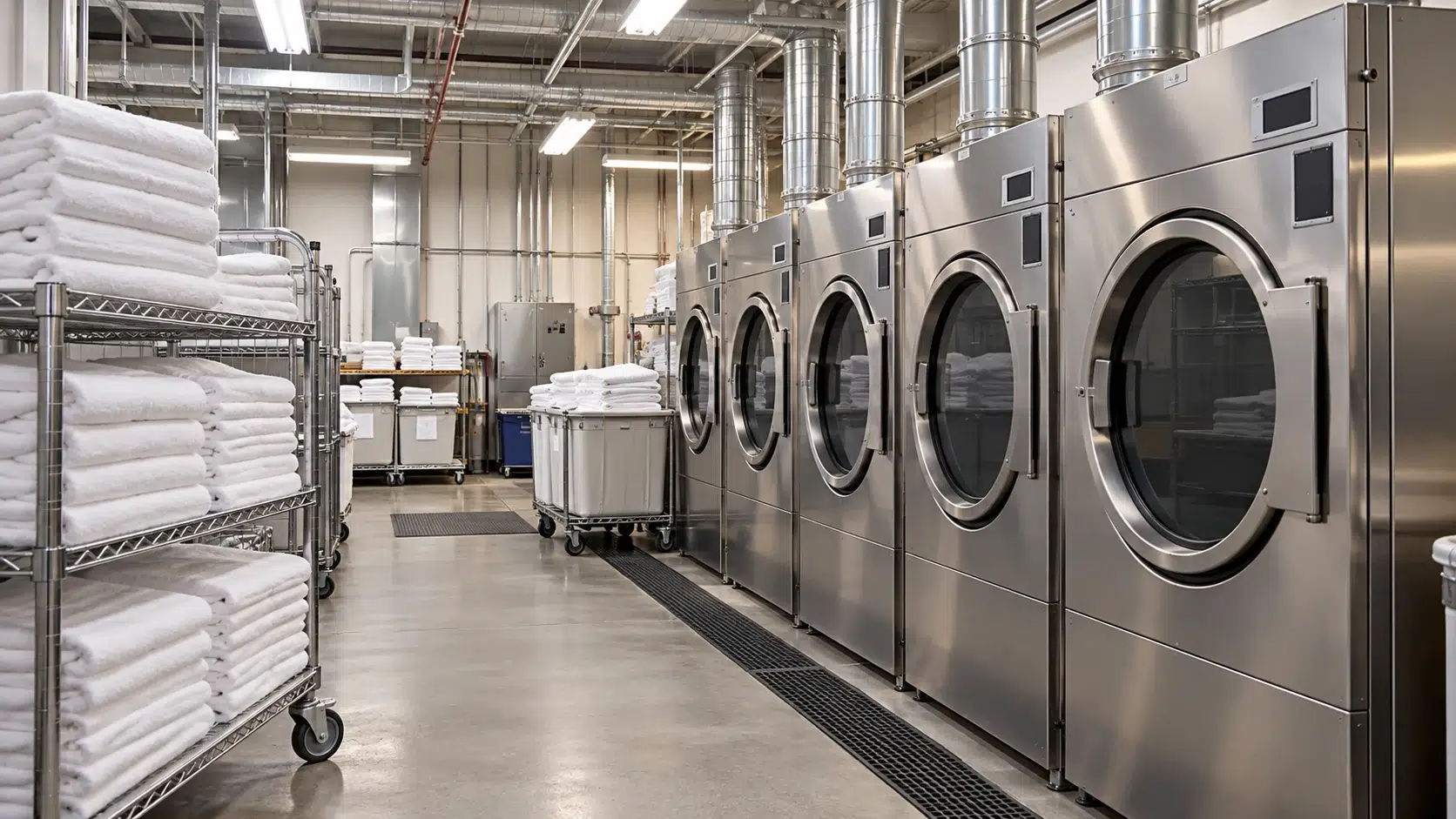


Plan exhaust maintenance around the laundry operation and the actual equipment. AI-generated illustration, not a customer property.
Hotel dryer vent cleaning in Denver should follow the installed equipment’s maintenance instructions and an inspection of the exhaust path. Plan service around lint accumulation, operating hours, and system condition. Cleaning the lint screen is essential routine care, but it does not replace maintenance of the ductwork carrying dryer exhaust outdoors.
When towels need another cycle, housekeeping loses time before anyone opens an equipment panel. A dryer problem can become a room-turnover problem. The answer may involve the exhaust, the appliance, the washer’s extraction performance, or the way loads are prepared. A maintenance plan should help you tell those possibilities apart.
This guide focuses on on-premises hotel laundries and their commercial exhaust systems. It is designed for engineering teams, hotel managers, and operators comparing service proposals, rather than homeowners booking a single dryer visit.
Start with an equipment list: dryer model, identification number, fuel type, and the rooms or functions it serves. Match the list to available mechanical drawings and the manufacturer’s documentation. Record which exhaust sections are accessible and who controls roof or service-area access.
Establish whether each dryer has a separate route or is connected to an engineered common exhaust arrangement. Where present, identify fans, controls, and collection devices. Do not infer the layout from a row of identical machines. A contractor needs to understand the actual system before proposing cleaning or shutdowns.
Ask about our dryer duct cleaning service with that information in hand. Confirm capability for your equipment, exhaust configuration, access needs, and required work window. A hotel laundry needs a site-specific scope.
A short operating log is more useful than a general statement that the machines seem slower. Track the machine, program, approximate load, cycle duration, and whether a repeat cycle was needed. Compare similar loads and settings. A towel load and a mixed linen load are poor benchmarks for each other.
Note recent changes: a different wash program, wetter loads, increased laundry volume, a new operator, or appliance maintenance. These details help the service team investigate without assuming that lint is the only explanation.
| Observed change | Useful investigation | Information to keep |
|---|---|---|
| One dryer takes longer than comparable machines | Appliance condition and that machine’s exhaust path | Machine ID, load, program, repeat cycles |
| Several dryers slow down during the same shift | Shared exhaust conditions if present, room air supply, loading, and controls | Which machines ran together and when |
| Lint appears behind a dryer | Accessible connections and equipment condition | Location, date, photographs |
| The laundry room becomes unusually hot or humid | Exhaust, room ventilation, and appliance operation | Timing and machines operating |
| An alarm, abnormal odor, or overheating occurs | Prompt assessment under the site’s safety procedure | Alarm details and actions taken |
A burning smell, smoke, or suspected fire is not a reason to book a routine future cleaning. Stop using the affected equipment when safe, follow the hotel’s emergency procedure, and obtain urgent help as appropriate. Do not keep restarting a machine that trips or overheats.
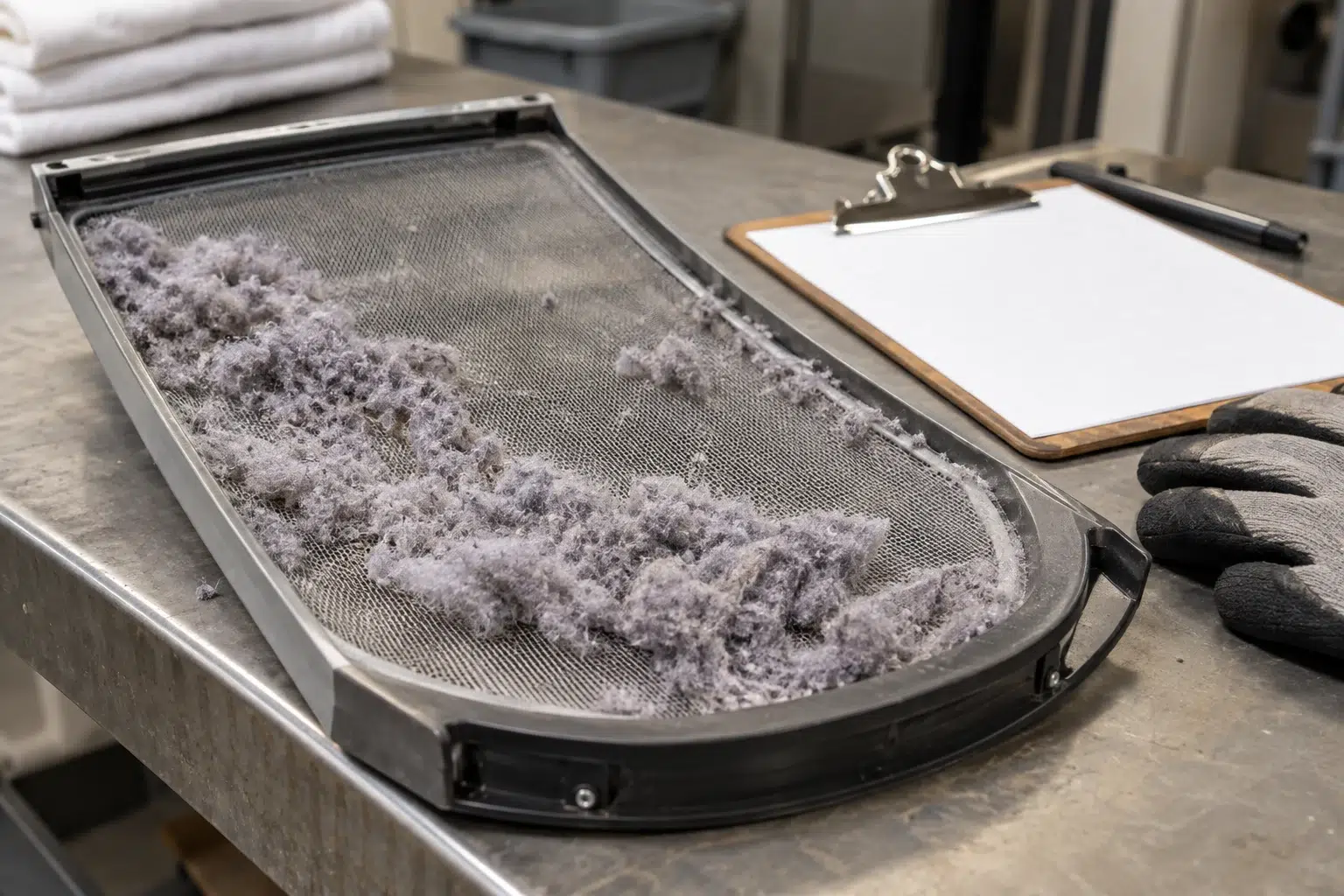
Keep operator lint-screen care, appliance maintenance, and exhaust-duct service as separate entries in the maintenance plan. Assign each task to a responsible person and use the instructions for the installed model. Completing one entry should not automatically close the others.
Manufacturer guidance is model-specific. One Alliance commercial dryer service manual gives a six-month exhaust inspection interval, while a separate installation manual calls for an inspection and cleaning program informed by experience at the location. Neither example establishes a universal cleaning schedule for every hotel.
Ask the equipment specialist and cleaning contractor to agree on an initial review interval, then adjust from documented conditions without extending beyond applicable requirements. Record operating changes that may justify an earlier review. Do not carry a residential annual-cleaning recommendation straight into a busy laundry.
The proposal should state the start and end points of each exhaust route included. It should identify access, collection methods, termination inspection, inaccessible sections, and any shared-system limitations. Ask whether separate appliance work or fan service needs another qualified contractor.
Include responsibility for isolation, reconnection, and return to service. Hotel staff should not be expected to improvise gas, electrical, or controls work to keep the cleaning appointment moving. Agree in advance on how defects will be reported and how additional work will be authorized.
Our dryer vent cleaning service page provides the general service overview. For a commercial laundry, request written confirmation of the specific routes and components covered. Duct cleaning cannot correct an unsuitable exhaust design or repair a failed appliance component by itself.
Choose a service window using expected linen demand, available clean stock, and the capacity that will remain offline. A quiet guest-facing period may still be a busy laundry shift. Bring housekeeping into the discussion before committing to a time.
Phased cleaning may be possible when the system allows safe isolation. A common exhaust arrangement may require a broader shutdown. Let the system assessment determine the plan, then confirm staffing, access, and the restart sequence.
If you are also planning commercial comfort-air duct cleaning, treat it as a separate system and scope. Hotel laundry exhaust and guest-area HVAC do different jobs.
Denver Fire Department inspects commercial occupancies for fire-code compliance. Its fire safety inspection guidance explains the local inspection process and contacts. Direct property-specific compliance questions to the responsible authority.
A cleaning report is a maintenance record. It does not, by itself, certify compliance, satisfy every insurer’s requirement, or guarantee that a laundry cannot have a fire. Keep the equipment instructions, service records, relevant inspection correspondence, and unresolved corrective actions together.
Request a route-by-route completion record with location-labeled photographs, access limitations, and any observations needing repair or specialist assessment. If performance readings form part of the agreed service, record the method and operating conditions so a future comparison has meaning.
A bucket of removed lint is not a measurement of exhaust performance. Neither is a photograph of a clean section proof that every concealed section was reached. Keep the report specific about what was inspected, cleaned, and left unresolved.
Send the hotel address, dryer count and models, approximate operating hours, known exhaust layout, access restrictions, and the maintenance concern. Include recent service history and your preferred downtime window. Ask about assessment availability and any information needed before a quote can be finalized.
Contact Red Rocks Air Duct about your hotel laundry exhaust or call below. Request a written scope that identifies the affected equipment, exclusions, and coordination needed with your engineering team.
Use the installed model’s instructions, applicable requirements, operating pattern, and inspection findings. Exhaust inspection and cleaning intervals are not necessarily identical. A high-use laundry should not rely on a household schedule. Record the initial condition and subsequent accumulation so the next service decision has a documented basis.
No. Screen care is a routine operator task, while the appliance and exhaust route have their own maintenance requirements. A clean screen does not establish that the downstream duct is clear. Assign the separate tasks and keep their records distinct so a completed daily check does not mask overdue exhaust maintenance.
It may help if exhaust restriction is contributing to the problem, but repeat cycles can also involve loading, wash extraction, settings, or an appliance fault. Compare similar loads and document the pattern. If performance remains poor after agreed exhaust work, have the appropriate equipment specialist investigate rather than assuming more cleaning is the answer.
Only if the assessed layout and isolation plan allow it. Separate-looking machines may share exhaust equipment or controls. The cleaning contractor and hotel engineering team should agree on which machines must be stopped and how they will be restored. Plan linen coverage for the confirmed shutdown rather than an assumed machine-by-machine sequence.
The dryer count is only a starting point. Duct routes, access, terminations, shared equipment, accumulated material, work restrictions, and reporting requirements affect the scope. Ask bidders to identify the same routes and exclusions. A residential single-dryer price is not a dependable estimate for a commercial laundry.
No. The invoice records purchased maintenance, while a fire inspection evaluates applicable conditions at the property. Keep the cleaning report and any corrective-action documentation available, and ask the responsible inspector about property-specific requirements. Do not treat a contractor’s general statement as an official inspection approval.
Research checked October 16, 2026. Written with AI assistance using public technical guidance; no customer case study or measured result is claimed. Images are AI-generated illustrations. Technical references: Alliance commercial dryer installation and service manuals; Denver Fire Department fire safety inspection guidance.