
Professional Dryer Vent Cleaning in Denver: What to Expect From the Service



Your dryer’s lint screen catches some of what your clothes shed, but not all of it. The rest travels with the heated exhaust air through the vent duct, cools slightly as it moves, and sticks to the interior walls in a thin layer. Repeat that process across hundreds of drying cycles and the duct narrows steadily with accumulated lint deposits that are both flammable and increasingly restrictive to airflow.
Dryer vent cleaning in Denver is the professional removal of that accumulated lint and debris from the entire duct run, from the connection at the back of the dryer to the exterior vent cap on the outside of the building. The distinction matters because most homeowners who clean their dryer vents at all are only addressing the visible parts: the lint screen after each load and occasionally the exterior flap. Neither of those reaches what builds up inside the duct itself.
This guide covers what professional dryer vent cleaning involves, how Denver’s specific housing stock and climate create unique challenges, and why the warning signs that your vent needs attention are worth acting on before the problem turns into a fire or an appliance failure.
Dryer vent cleaning is not the same as cleaning the lint screen. The screen catches the largest debris before it enters the duct, but fine lint particles pass through and deposit throughout the full length of the duct run. Professional cleaning removes those deposits from every section of the system.
A complete dryer vent cleaning typically includes:
Full duct inspection to assess the length of the run, the number of bends, and the current level of lint accumulation before any cleaning begins
Lint removal from the entire duct run using professional rotary brush equipment and high-powered vacuums, not the flexible brush kits available at hardware stores
Exterior vent cap cleaning and inspection to clear debris, bird nests, or pest blockages that restrict airflow at the point of discharge
Transition hose inspection to check the flexible connector between the dryer and the rigid ductwork for kinks, crushing, or improper materials that increase fire risk
Post-cleaning airflow verification to confirm that airflow has been restored to proper operating levels before the technician leaves
This full-system approach is what addresses the actual fire hazard. Cleaning only the accessible sections leaves lint deposits in the middle and far sections of longer duct runs, which is where most of the combustible buildup occurs in Denver homes with extended vent paths.
Residential air duct cleaning addresses the HVAC system: the supply and return ducts that distribute conditioned air throughout the home. The contamination there is primarily dust, pollen, pet dander, and in Denver, construction debris and wildfire smoke particles.
Dryer vent cleaning is a completely separate service that addresses a separate system with a different contamination profile and a more immediate fire risk. Lint is highly combustible. When the National Fire Protection Association identifies the leading cause of dryer fires as failure to clean, they’re referring specifically to lint accumulation in the vent duct, not the HVAC system.
The equipment is also different. HVAC duct cleaning uses tools sized and designed for large-diameter supply and return runs. Dryer vent cleaning uses rotary brush systems and specialized vacuums designed to work through the smaller diameter and longer runs typical of dryer exhaust venting. Combining the two into one service call requires technicians and equipment that cover both, which Red Rocks Air Duct provides as part of its dryer vent cleaning service.
There is no single interval that fits every home. A useful baseline is to have the dryer exhaust system inspected at least yearly and cleaned whenever lint buildup, restricted airflow, or the dryer manufacturer’s instructions call for it. CSIA recommends annual dryer-exhaust inspections; homes with heavy laundry use, long duct runs, multiple bends, pets, or a history of weak airflow may need service more often.
| Situation | Why it may need closer attention |
| Large household or frequent laundry | More loads create more lint and faster buildup. |
| Long or complex vent run | Each bend and added length can reduce airflow and create places for lint to collect. |
| Condo, apartment, or multi-unit property | Access, shared building systems, and management responsibilities can make inspection more important. |
| Drying takes longer or the laundry room gets hot | These are practical signs to arrange an inspection now rather than wait for a routine interval. |
Current model codes commonly use a 35-foot maximum developed length as a starting point for domestic dryer exhaust ducts, with reductions for fittings; the dryer manufacturer’s installation instructions and the specific configuration control in practice. That is why an on-site inspection is more useful than applying a generic schedule to every Denver home.
This household guidance is not a maintenance schedule for an on-premises hotel laundry. For commercial equipment, use our hotel dryer vent maintenance guide alongside the installed model’s instructions and a system assessment.
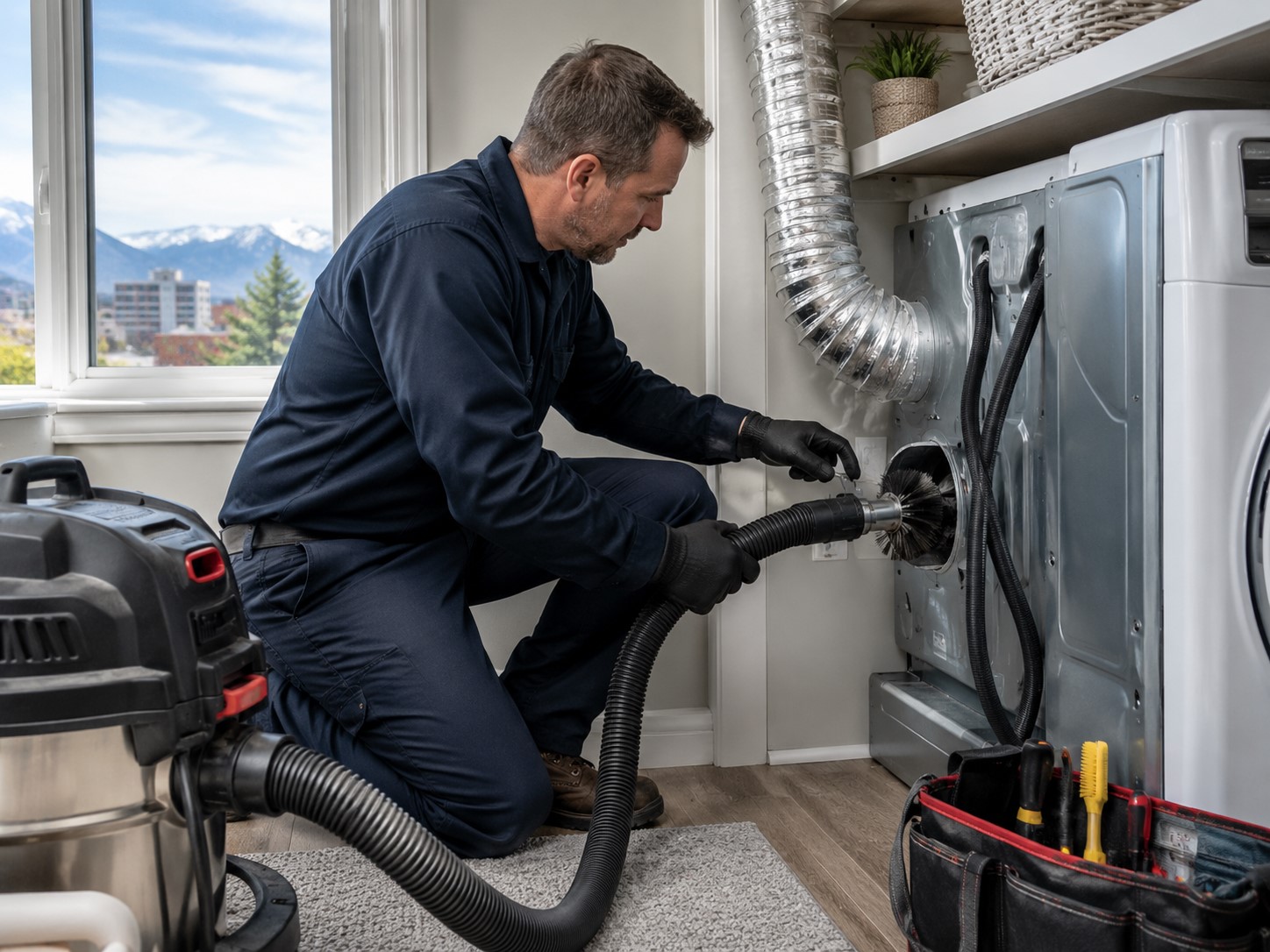
Older homes and remodels can create longer, less direct duct routes. In established Denver neighborhoods such as Capitol Hill, Baker, the Highlands, and Sunnyside, laundry equipment may have been moved during a remodel or placed far from an exterior wall. That can mean a dryer exhaust duct travels through a basement, ceiling, or finished wall and includes several turns. Longer, more complex routes deserve professional evaluation because airflow and code-compliant length depend on the complete configuration, not on the visible connection behind the dryer.
Exterior terminations need periodic inspection. Windblown debris, nests, damaged louvers, and snow or ice around an exterior termination can interfere with exhaust. A technician can inspect the outside cap as part of a full cleaning and confirm it opens freely while the dryer runs. Do not add a screen that traps lint at the termination unless the dryer manufacturer and local code allow it.
Multi-unit buildings require coordination. Condos and apartments may have harder-to-access duct paths or building-managed exhaust components. Residents should check their lease or HOA rules before authorizing work beyond the in-unit connection, while managers should document maintenance responsibilities for common or shared components.
Most dryer vent blockages develop gradually, and the symptoms are easy to dismiss or misattribute to the dryer itself rather than the vent. A few consistent indicators signal that cleaning is overdue:
Clothes taking longer than one cycle to dry completely. A properly vented dryer should dry a standard load in 45 to 60 minutes. If you’re running two cycles for a single load, restricted airflow from lint buildup is usually the cause before the dryer itself is at fault.
The dryer or laundry room is noticeably hot during a cycle. When the vent is blocked, heat that should be exhausting to the outside builds up in the dryer and the surrounding space. A laundry room that’s significantly hotter than the rest of the house during a cycle is a warning sign worth acting on immediately.
Burning or musty smell during operation. A burning smell can indicate lint that’s hot enough to smolder but hasn’t yet ignited. A musty smell suggests moisture that can’t escape through a blocked vent, which creates conditions for mold growth inside the duct.
The exterior vent flap doesn’t open during operation. Step outside during a drying cycle and check the exterior vent cap. If the flap isn’t visibly moving or if airflow at the opening is weak, the duct has enough restriction to prevent normal exhaust.
Visible lint on the exterior vent cap or around the dryer. Lint escaping backward around the dryer connection or accumulating visibly at the exterior cap indicates that the duct is full enough to be pushing lint backward rather than exhausting it forward.
None of these symptoms require dryer replacement. They require vent cleaning, which resolves airflow issues immediately in most cases.
Neglecting dryer vent cleaning creates a compounding set of problems that grow more serious the longer the vent goes without service.
Increased fire risk. Lint ignites at temperatures easily reached inside a restricted dryer vent. The U.S. Fire Administration identifies failure to clean as the leading cause of residential dryer fires, accounting for thousands of home fires annually across the country. The fire typically starts inside the duct itself, where lint has reached ignition temperature from the restricted hot air that can no longer move efficiently through the system.
Higher energy costs. A dryer working against a restricted vent runs longer and uses more energy to achieve the same result. Extended cycle times add up quickly for high-use Denver households, especially during winter months when natural gas or electric costs are already elevated.
Premature appliance failure. Dryers are designed to operate within specific temperature and cycle-time parameters. Running against consistent backpressure from a blocked vent stresses the heating element, motor, and drum seals in ways that accelerate wear. Restricted airflow can place extra heat and operating stress on the dryer. The exact effect varies by appliance, use, and maintenance history, but restoring proper exhaust is a sensible first step before assuming the dryer itself needs major repair.
Moisture and odor concerns. Poor exhaust can leave excess moisture in the laundry area or duct system. A musty odor, visible water, or suspected mold should be assessed promptly because the cause may involve the exhaust path, dryer operation, or a separate building moisture issue.
Annual dryer vent cleaning costs a fraction of any of these outcomes. It’s maintenance that pays for itself in extended appliance life, lower energy bills, and the avoided cost of a fire that shouldn’t have happened.
Dryer vent cleaning is not priced well by a one-size-fits-all promise because the work can vary significantly from one property to another. The main factors are the duct’s accessible length, number of turns, dryer location, roof or exterior access, visible damage, bird-nest or debris removal, and whether the transition connector needs replacement. A trustworthy estimate should explain what part of the system is included and identify any extra work before it begins.
For homeowners, the useful question is not simply “What is the cheapest dryer vent cleaning?” but “Will the technician clean the full run, inspect the exterior termination, and confirm that airflow has improved?” Ask that before scheduling, especially for older homes, condos, or any property where the route is long or hidden.
Cleaning removes lint and debris; it does not correct every exhaust problem. A technician may recommend a repair or further evaluation when the duct is crushed, disconnected, made from unsuitable material, excessively long for the appliance, or terminated improperly. In those cases, cleaning is still useful, but correcting the configuration is what restores a safer long-term result.
Red Rocks Air Duct provides professional dryer vent cleaning across the Denver metro area, including residential properties in Capitol Hill, Baker, the Highlands, Wash Park, and surrounding neighborhoods, as well as condos, apartment complexes, and multi-unit properties in LoDo, RiNo, and the DTC corridor.
Services include:
Full duct inspection and airflow measurement before and after cleaning to document the improvement and confirm the system is operating within safe parameters
Professional rotary brush equipment designed for thorough lint removal from the complete duct run, including sections that consumer brush kits can’t reach
Exterior vent cap inspection and clearing, including removal of bird nests, pest blockages, and accumulated debris at the discharge point
Transition hose assessment with recommendation to replace flexible plastic or accordion venting that creates unnecessary fire risk compared to rigid or semi-rigid metal ductwork
Combined service scheduling with residential air duct cleaning for homeowners who want both systems addressed in a single appointment
A professional service visit should include an assessment of the full accessible run, the exterior termination, and any visible configuration concerns that affect airflow or safety. Our dryer duct cleaning service covers both the vent line and the connection components to ensure the full system is addressed in a single visit.
Denver’s range of housing types – from 1890s Victorian homes in Capitol Hill to 1960s ranch-style homes in Wheat Ridge to new construction condos in RiNo – creates a wide variety of dryer vent configurations, and each comes with its own maintenance challenges.
Historic homes in established neighborhoods. Properties in Baker, Capitol Hill, the Highlands, and Curtis Park often have dryers installed in locations that require long vent runs through finished walls or ceilings. These routes can’t be accessed without knowing where the duct travels, and a technician unfamiliar with these configurations may miss sections of the run entirely. Many of these homes also have original ductwork materials from before rigid metal venting became standard, including flexible foil and plastic accordion hoses that should be replaced rather than simply cleaned.
Multi-unit condos and apartment buildings. Denver’s rapidly expanding condo market in neighborhoods like RiNo, Five Points, and the DTC corridor includes many buildings where individual unit dryer vents connect to shared vertical stacks or horizontal manifold systems that run between units before exiting the building. These systems accumulate lint at every connection point and transition, and a blockage in a shared section affects multiple units simultaneously. Building managers responsible for these properties should schedule regular professional cleaning rather than leaving it to individual residents.
New construction homes in suburban communities. Homes in newer suburban developments like those in Aurora, Centennial, Highlands Ranch, and Commerce City often have longer vent runs than older homes because laundry rooms are placed in interior locations away from exterior walls. A dryer vent that travels 35 feet through a finished basement before exiting at grade level needs professional cleaning equipment to address the full run, and it needs that cleaning more frequently than a shorter residential vent because lint accumulates proportionally to duct length.
A few patterns show up consistently when Denver homeowners call us after a close call or an appliance failure:
Relying on lint screen cleaning as the only maintenance. The lint screen is a filter, not the vent. Cleaning it after every load is correct and necessary, but it doesn’t address what’s accumulating in the duct. A dryer that’s been running for years with a clean lint screen and a never-cleaned vent duct still has years of accumulated lint deposits in the system.
Using flexible plastic or accordion foil venting. These materials are inexpensive and easy to install, which is why they’re still common in Denver homes despite being a known fire hazard. They trap lint in their ridged interior surfaces and can collapse or kink in ways that rigid metal ductwork doesn’t. If your dryer is currently vented with plastic or accordion foil, the duct material itself is a problem that cleaning alone doesn’t fully address.
Assuming the dryer is broken when it’s the vent. A dryer that’s taking two cycles to dry a load is almost always dealing with a restricted vent rather than a failed component. Calling an appliance technician rather than a duct cleaning service often results in an unnecessary service call and sometimes an unnecessary part replacement. If your dryer recently stopped drying efficiently, have the vent inspected and cleaned before spending money on appliance diagnostics.
Not accounting for duct length in cleaning frequency. Annual cleaning is appropriate for a standard 10 to 15-foot duct run with a single 90-degree bend. A 35-foot duct run through two floors with three bends needs to be cleaned more often. Cleaning frequency should reflect how much lint the specific duct accumulates, which is a function of household usage and duct design, not just a standard annual schedule.
Dryer vent cleaning is one of the simplest and most effective fire prevention measures available to Denver homeowners, and it’s consistently one of the most neglected. The lint that accumulates in dryer vents during normal household laundry operations is combustible, it builds up whether or not you can see it, and it creates both a fire hazard and a progressive efficiency problem that affects every load you dry.
Professional cleaning removes lint from the entire duct run, restores airflow to safe operating levels, and identifies any duct condition issues – improper materials, excessive length, or damaged transition hoses – that increase fire risk beyond what lint accumulation alone creates.
Next steps:
Check how long it’s been since your dryer vent was last professionally cleaned and compare it to the frequency guidelines for your household type
Step outside during a drying cycle and verify that your exterior vent cap is opening freely and that you can feel airflow at the discharge point
Schedule a professional inspection with Red Rocks Air Duct if your vent hasn’t been cleaned in the past year or if you’re noticing any of the warning signs covered in this guide
How often should dryer vents be cleaned in Denver?
Annual inspection is a sensible baseline for most households, and CSIA recommends annual dryer-exhaust inspections. In Denver, homes with longer duct runs through older neighborhoods like Capitol Hill or Baker, households with heavy laundry volume or pets, and condos with shared vent stacks should consider cleaning every six months. The most reliable way to determine the right frequency for your specific setup is to have a technician measure airflow before and after cleaning – if there’s a significant difference, the buildup rate justifies more frequent service.
How do I know if my dryer vent is clogged?
The most common indicators are clothes taking more than one cycle to dry fully, the dryer or laundry room feeling unusually hot during operation, a burning or musty smell while the dryer runs, and weak or no airflow at the exterior vent cap during a cycle. Any one of these symptoms warrants a professional inspection. A dryer that’s recently stopped drying efficiently but otherwise seems to be functioning normally is much more likely to have a clogged vent than a failed component.
Can I clean my dryer vent myself?
Consumer dryer vent brush kits can clear lint from the first few feet of accessible duct, but they don’t reach the full length of most vent runs and can’t provide the mechanical agitation needed to dislodge compacted lint from duct walls further into the system. In Denver homes with long horizontal runs or multiple bends, DIY cleaning typically removes less than half of the accumulated lint while providing a false sense of security. Professional equipment, which includes rotary brush systems and high-powered extraction vacuums sized for dryer duct diameters, addresses the full duct run and can verify the result with airflow measurement.
What type of dryer venting is safest for Denver homes?
Rigid aluminum or galvanized steel ductwork provides the best fire safety profile for dryer venting. Its smooth interior surface minimizes lint adhesion compared to ridged flexible materials, and it maintains its diameter through bends rather than collapsing or kinking. Semi-rigid aluminum is acceptable for the transition section between the dryer and the rigid duct. Plastic or flexible foil accordion venting is not recommended by most dryer manufacturers, fire safety organizations, or building codes for new installations, and existing plastic or foil venting should be replaced rather than simply cleaned.
Does Red Rocks Air Duct clean dryer vents in condos and apartment buildings?
Yes. Red Rocks Air Duct provides dryer vent cleaning for individual condo and apartment units as well as multi-unit buildings where the vent system serves multiple units or uses a shared stack. Building managers can schedule service for individual units or for full-building cleaning during periods of low occupancy. Contact us to discuss scheduling and service options for your property.
What’s the difference between dryer vent cleaning and dryer duct cleaning?
Both terms refer to the same essential service: professional removal of lint and debris from the dryer exhaust system. Some providers use “vent cleaning” to describe the full duct run and “duct cleaning” to refer specifically to the rigid ductwork sections, but in practice, a complete service covers everything from the dryer connection to the exterior termination. Red Rocks Air Duct provides both dryer vent cleaning and dryer duct cleaning as comprehensive services that address the entire system rather than individual sections. If you’re unsure which applies to your situation, a call to our team before scheduling will confirm what your specific setup needs.